
Two kitchen bids can look almost the same. But one might include better cabinets, permits and daily cleanup, while the other leaves them out. That is why choosing a kitchen remodeling contractor in Costa Mesa starts with checking what each bid really covers, not just the price at the bottom.
This guide walks you through it step by step. You will learn how to check a license, ask for insurance, compare bids, talk to references and spot red flags before you sign anything.
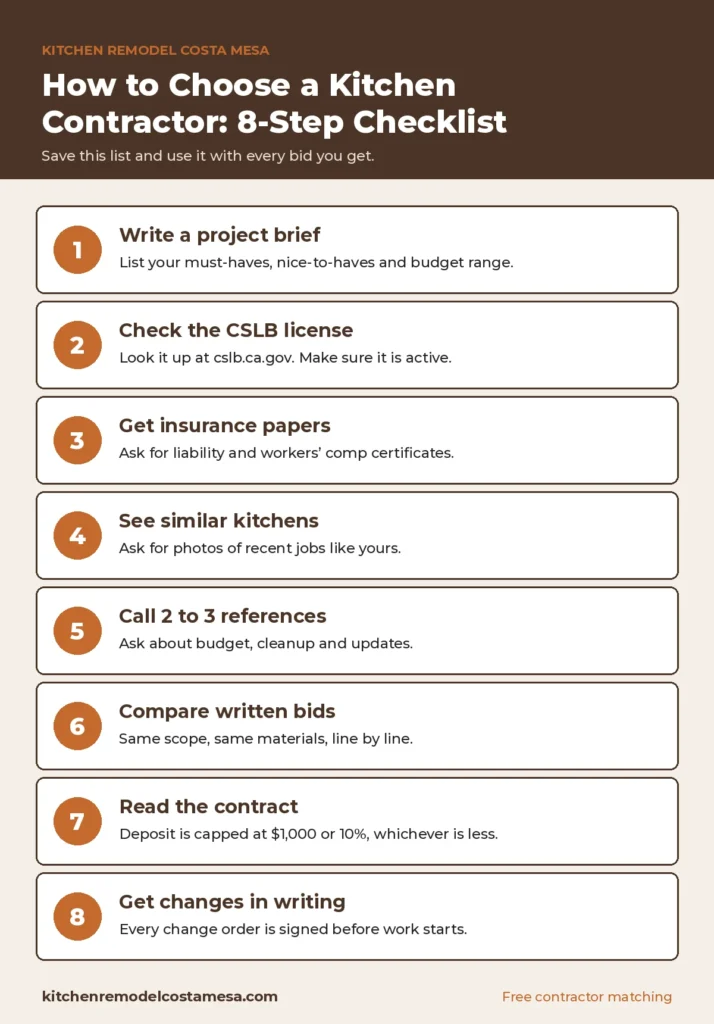
- Check the license on the CSLB website.
- Ask for proof of insurance.
- Look at kitchens they have done that are like yours.
- Call two or three recent references.
- Compare at least three written bids for the same scope.
- Read the contract before you pay. In California, the deposit can be no more than $1,000 or 10% of the price, whichever is less.
Start With a Clear Plan for Your Kitchen
Before you call anyone, decide what kind of project you want. Is it a quick update, a partial remodel or a full kitchen remodel? New countertops and hardware are a very different job than moving the sink or taking out a wall.
Write down what you want to change. Think about cabinets, countertops, lighting, plumbing, electrical and layout. Then split the list in two: must-haves, and things that can wait if the bids come in high.
Gather a few basics to share: rough measurements, photos of your kitchen, the appliances you want and pictures of finishes you like. Also explain what bugs you about the kitchen now. Maybe there is not enough storage. Or maybe it is a long walk between the sink, fridge and stove. Designers call that path the “work triangle.”
Pick a budget range, and set aside extra money and time for surprises. Not sure what is realistic? Our Costa Mesa kitchen remodel cost guide breaks down local price ranges. Looking for inspiration? See our kitchen remodel ideas for Costa Mesa homes.
Match the Contractor to the Size of the Job
A kitchen-focused contractor is often a great fit for cabinets, tile and finish work. Bigger jobs, like a kitchen layout redesign or removing a wall, may call for a general contractor. If structural problems or seismic work could be part of the job, you may also need a structural engineer. Bring these up early.
Ask who will handle demolition, electrical, plumbing and inspections. A good contractor can tell you who manages each trade and who fixes problems when two crews’ work overlaps.
Check the License and Insurance
Look up every contractor on the CSLB Check a License page. CSLB stands for the Contractors State License Board. Do not rely on a badge on a website or a number painted on a truck. The CSLB says a license number on display does not mean the license is valid, so check it yourself.
The lookup shows if the license is active, what type it is and any past discipline. Make sure the business name on the license matches the name on your bid and contract. Then check again right before you sign.
For a bigger remodel, many contractors hold a Class B General Building license. Under CSLB’s Class B guidance, a Class B contractor can take jobs that involve at least two unrelated building trades, and framing or carpentry does not count as one of them. Ask how their license fits your project.

Ask for Proof of Insurance
Ask for current certificates for general liability insurance and workers’ compensation. The CSLB suggests checking coverage with a certificate or by calling the contractor’s insurance company.
Here is why it matters. In California, contractors with employees must carry workers’ comp. General liability insurance is not required, but it can help pay for damage to your home. Ask who employs the crew working in your house and how subcontractors are insured.
If the license record shows a workers’ comp exemption, ask how that fits with who will actually do the work. You want this to be clear before anyone starts.
Look for Real Kitchen Experience
Ask to see recent kitchens like yours, in size and difficulty. Ask about cabinets, tile, countertops, waterproofing and electrical upgrades.
Local experience helps too. An older ranch home in a neighborhood like Mesa Verde can raise different questions than a newer coastal-style home. Ask about homes like yours instead of just accepting “we know the area” as the answer.
Better Business Bureau ratings can be one more clue. But they do not replace checking the license, insurance, references and contract.
Read Reviews and Talk to References
Read recent reviews and look for patterns. Do people mention schedules, communication, quality, cleanup or how problems got fixed? A few detailed reviews tell you more than a star rating.
Watch how the contractor responds to complaints. A problem that was fixed is very different from one that was ignored.
Ask each finalist for two or three recent references with kitchen jobs like yours. For a big remodel, talk to people whose projects included several trades and inspections. Then compare what they say with what the contractor promised you.
Questions to Ask References
- Did the project stay close to the plan you agreed on?
- How were extra costs explained and approved?
- Did the crew use plastic barriers to keep dust out of other rooms?
- Was the work area cleaned up every day?
- Did you get regular updates, like weekly photos?
- Did you have one main person to contact?
- Were warranty issues handled quickly after the job was done?
End with one more: “What would you make clearer if you hired them again?” The answer often points to contract details worth adding, even when the homeowner was happy overall.
Get at Least Three Written Bids
Give every contractor the same project plan so you can compare fairly. The CSLB recommends at least three written bids based on the same plans, specs and scope of work.
A very low bid is not always bad, but it needs questions. The CSLB warns that a much lower bid may mean a mistake or missing work. Ask the contractor to explain why their price is different.
Look Closely at Materials and Allowances
Ask for the brand and product line for cabinets, countertops, hardware, fixtures, tile and appliances. If you picked soft-close drawers, quartz countertops or special finishes, they should be written into the bid. Our cabinet installation and countertop installation pages explain common choices.
An allowance is a placeholder budget, not a final product choice. Ask what it includes: just the product, or also delivery, installation and extra parts? And how will you be charged if your pick costs more?
Talk about supplier delays and which substitutions are okay before anything gets ordered.
Ask How the Schedule Works
Ask for a timeline with key steps: design choices, ordering, demolition, rough-in work, inspections, installation and the finish date. Cabinet delivery and countertop fabrication should fit into that timeline.
Ask what happens to the schedule if they find water damage or old wiring. A useful timeline shows what depends on what, not just a start date and a hopeful finish date.
Pay Attention to How They Communicate
Notice if the contractor answers your real questions. Do they explain the pros and cons without pushing you to decide fast? Clear answers about cost, materials and timing are worth more than big promises about quality.
Find out who your main contact is and who takes over when that person is out. Ask who supervises subcontractors and who can make decisions for the company.
Agree on how often you will get updates before work starts. A weekly summary can cover finished work, what is next, photos, open choices and decisions that need your OK.
Also ask how fast you need to answer questions. If a cabinet finish is not picked on time, the cabinet order can slip, and so can the whole schedule.
Plan for Surprises and Changes
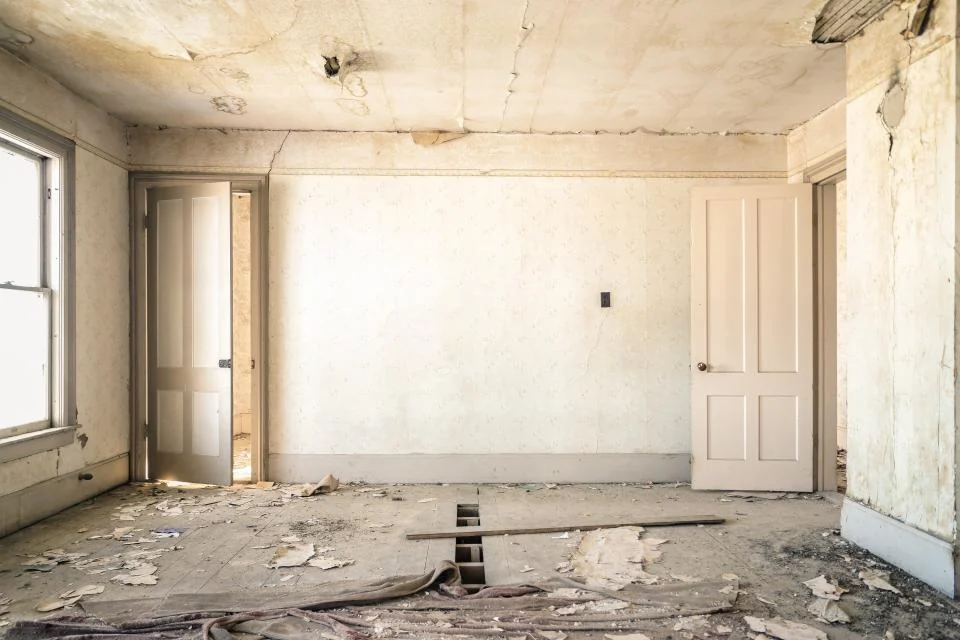
Once walls and floors come apart, crews can find water damage, old wiring, plumbing problems or structural issues that were hidden before. Required code updates can also change the plan.
In California, if the price or scope changes, the CSLB requires a written change order signed by you and the contractor before the change. Ask how they will make urgent problems safe while you review the fix.
Keep all approvals in one place, like email or a project app. A phone call should never be the only record of an expensive decision.
Read the Contract Before You Pay a Deposit

The contract should match the bid you accepted. It should list the contractor’s legal business name and license number. Fix any differences between the bid, drawings and material choices before you sign.
Check that it covers the scope, schedule, payment steps, materials, permits, cleanup and warranty. It should also say who schedules inspections and how the job will be marked complete.
Tie later payments to finished work, like “cabinets installed,” not just to dates on a calendar. Keep your contract, selections, invoices, approvals and change orders together in one folder.
Get the Warranty in Writing
There are two kinds of warranty. The contractor’s warranty covers their work. Manufacturer warranties cover products like cabinets and fixtures. Ask what each one covers, how long it lasts and what is not included.
The paperwork should explain how to report a problem and who will fix it. Ask what happens when it is not clear if the issue is a bad product or a bad install.
Do not settle for a spoken promise that they will “take care of everything” later.
Red Flags to Watch For
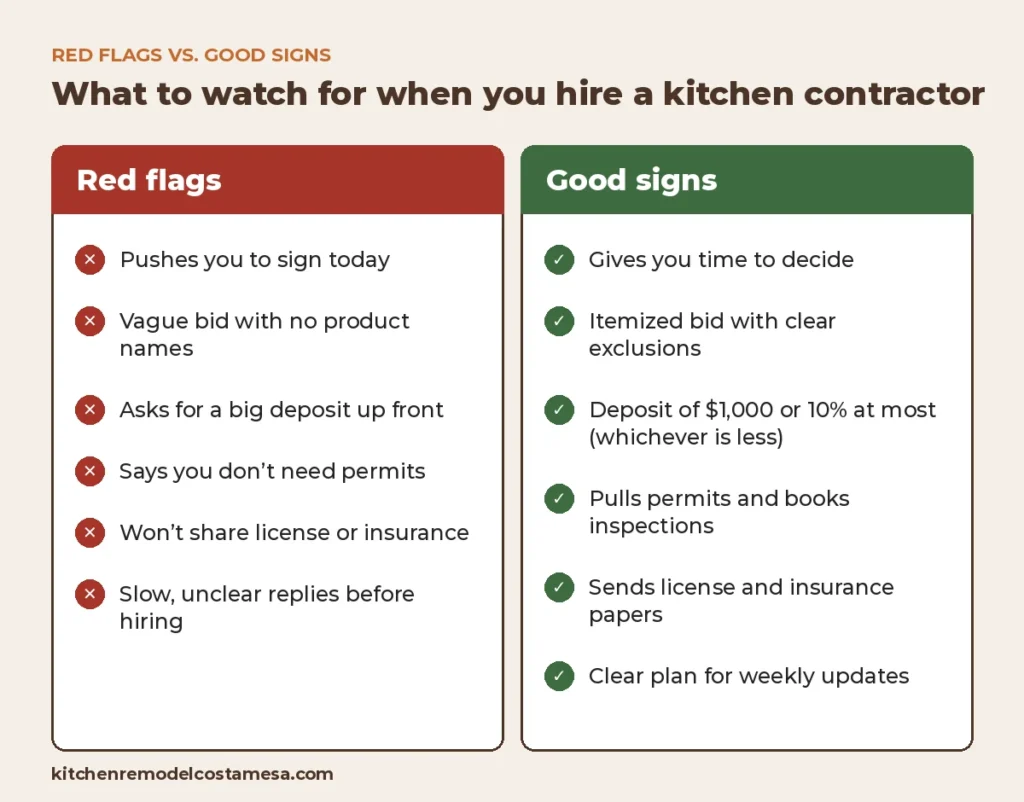
Pressure to sign right away is a reason to slow down, especially when the scope and materials are not settled. A “sign today” discount should never replace time to understand the deal.
Vague bids are risky too. Missing product details, unclear exclusions or a fuzzy payment plan make it hard to know what you are paying for.
Be careful if a contractor will not share license info, insurance papers, references or written warranty terms. Ask once. If they still will not, do not let friendly words take the place of real documents.
Also watch for big upfront payment demands and claims that permits or California building codes “don’t matter.” Poor communication before you hire is a warning sign, too. Once work starts, there are more decisions, not fewer.
What a Professional Process Looks Like
A qualified contractor can walk you through the order of the work: demolition, electrical, plumbing rough-in, inspections, installation and finish work. They can also tell you which steps depend on approvals or deliveries.
They will answer everyday questions too. How will floors be protected? Where will dust barriers go? What are the work hours? Where will the crew park? How will they get in and out of your home?
Most of all, a pro welcomes questions about quality checks and written changes. You should know how problems will be handled before you ever have to deal with one.
Find a Vetted Kitchen Remodeling Contractor in Costa Mesa
Kitchen Remodel Costa Mesa is a free contractor-matching service. We do not do the remodel ourselves. Instead, we handle the first round of screening and match you with one independent contractor who fits your project.
Our screening looks at CSLB license status, insurance papers, kitchen experience and local work in Costa Mesa. That gives you a strong starting point. You still review the bid, the contract and whether the contractor feels like a good fit.
The contractor gives you the estimate, scope and timeline. We do not set their prices, and there is no obligation to hire. Learn more on our About page or read our FAQs.
Get Ready for Your First Meeting
Share your goals, the layout you want, materials you like, your budget range and your timing. Mention any known problems and any decisions you have not made yet.
If you talk to more than one contractor, ask each one the same main questions so the answers are easy to compare. Ask them to put their advice, assumptions and exclusions in the written bid.
Afterward, write down which contractor explained limits clearly and asked smart questions about how your household uses the kitchen.
Make Your Final Choice With Confidence
Choose the contractor who has real kitchen experience, solid paperwork, a clear scope and good communication. Price matters, but only once you know what each bid includes.
Before you sign, make sure:
- Materials and allowances are clear enough to judge.
- Payments line up with real progress on the job.
- It is clear who handles permits and inspections.
- The schedule and your own deadlines are in writing.
- Every change needs written approval.
- Warranty terms and how to report problems are clear.
If two finalists seem equally good, call their references again and go back to any open questions. Often the best choice is the contractor who makes everything easiest to understand, not the one with the biggest promises.
Frequently Asked Questions
How do I check a contractor’s license in California?
Use the free CSLB Check a License tool. You can search by license number, business name or personal name. It shows if the license is active, its classification, bond and workers’ comp details, and any public complaints or discipline.
How much can a contractor ask for as a deposit in California?
For home improvement jobs, the down payment can be no more than $1,000 or 10% of the contract price, whichever is less. There is no exception for special-order materials.
How many bids should I get for a kitchen remodel?
The CSLB recommends at least three written bids based on the same plans, specs and scope of work. Matching scopes make it much easier to compare prices fairly.
What kitchen design trends are popular right now?
Popular choices include smart storage, soft-close drawers, quartz countertops, layered lighting and warm wood finishes. Pick features that make daily cooking easier and fit your home, instead of chasing every trend.
What should I do and avoid when remodeling a kitchen?
Do define your scope, check credentials, compare detailed bids and approve changes in writing. Avoid choosing the lowest bid without questions, putting off material choices, signing a vague contract or skipping permit and insurance checks.
Can I remodel my kitchen in Costa Mesa for $30,000?
$30,000 can cover a solid cosmetic refresh in Costa Mesa, such as new countertops, hardware, backsplash, lighting and some appliance upgrades. It usually will not cover semi-custom cabinets or a layout change. See our Costa Mesa kitchen remodel cost guide for local price ranges.
A careful hiring choice means you know who is doing the work, what you are paying for and how changes will be handled. That clarity is the foundation for the kitchen you want, and for a much smoother remodel.

One Comment